England head into the 2026 World Cup once again carrying the weight of expectation, whilst also being recognised as one of the strongest squads in international football. After consistent performances in recent major tournaments, belief remains high amongst fans and pundits across the UK.
This year's World Cup is set to run from 11 June to 19 July 2026, taking place across the United States, Canada and Mexico.
Whilst the final squad has not yet been confirmed, recent call ups, performances in World Cup Qualification, and international friendlies provide a strong indication of the core group expected to travel. England have shown both dominance and occasional vulnerability in recent fixtures, reflecting a side that is talented but still evolving.
Results over the past year highlight this balance. Comfortable wins against Serbia, Latvia and Andorra underline their attacking quality. This reinforces the idea that England are genuine contenders, albeit not without weaknesses.
Now, England are set to face Croatia, Ghana, and Panama in Group L of the 2026 World Cup.
From a betting perspective, England are consistently priced amongst the favourites across the best bookmakers in the UK. Whilst Spain and France are often slightly ahead in the market, England remain firmly within the top tier of contenders.
In this article, we will cover England’s latest squad insights based on recent selections, a predicted starting XI, key players to watch, tactical approach, recent form, historical World Cup performance, as well as a detailed breakdown of the latest odds across major bookmakers and whether England offer real value ahead of the 2026 tournament.
Here's what you'll find:
- Squad for the 2026 World Cup (Latest Insights)
- Starting XI Prediction
- Key Players to Watch
- Manager and Tactical Approach
- Recent Form and Results
- Fixtures at the 2026 World Cup
- World Cup History
- The Best Bookmakers for World Cup 2026
- Odds to Win the 2026 World Cup
- Can England Win the 2026 World Cup?

Do you like football? See today's matches!
Squad for the 2026 World Cup (Latest Insights)
The final England squad for the 2026 World Cup has not yet been officially confirmed, but recent call ups, international fixtures and club performances provide a clear indication of the players likely to be involved.
England’s current player pool reflects a strong balance between experienced internationals and emerging talent. Depth is evident across most positions, particularly in midfield and attack, where competition for places is especially intense.
Based on recent selections, the following players are among those expected to be in contention.
- Goalkeepers
England have a solid group of goalkeepers:
- Jordan Pickford
- Aaron Ramsdale
- Dean Henderson
- James Trafford
Pickford remains the most established option at international level. Ramsdale and Henderson continue to compete for opportunities, while Trafford is viewed as a long term prospect who could be included for experience.
- Defenders
Defensive options are both varied and competitive, with several players capable of operating in multiple roles:
- Harry Maguire
- John Stones
- Fikayo Tomori
- Ezri Konsa
- Marc Guéhi
- Ben White
- Kyle Walker
- Luke Shaw
- Reece James
Stones plays a central role in England’s build up, offering composure and distribution. Players such as Tomori and Guéhi provide mobility and recovery pace, while full backs add both defensive cover and attacking width.
- Midfielders
Midfield remains one of England’s strongest areas, offering control, creativity and physical presence.
- Jude Bellingham
- Declan Rice
- Phil Foden
- Cole Palmer
- James Maddison
- Conor Gallagher
- Kobbie Mainoo
Bellingham is expected to be central to England’s approach, supported by Rice in a deeper role. Creative options such as Foden and Palmer provide flexibility, while younger players like Mainoo continue to push for inclusion.
- Forwards
England’s attacking depth is among the best internationally, with a range of profiles available:
- Harry Kane
- Bukayo Saka
- Marcus Rashford
- Phil Foden
- Ollie Watkins
- Ivan Toney
- Anthony Gordon
Kane remains the focal point in attack, supported by wide players who offer pace and directness. Competition for attacking positions is strong, which could influence final selection decisions.
Squad Analysis
This is not a confirmed squad, but the overall depth and quality are clear. England have multiple options in key areas, particularly in midfield and forward positions, where competition is highest.
Defensively, there is flexibility in terms of player profiles and tactical setups, although consistency will be important. In attack, the variety of options allows different approaches depending on the opponent.
If current form is maintained, England are expected to travel to the 2026 World Cup with one of the strongest squads in the tournament.
English Squad

Starting XI Prediction
With no official squad confirmed yet, any starting XI projection must be based on recent selections, player form and tactical trends observed in England’s recent matches.
England are expected to favour a flexible system, most commonly a 4-3-3 or a variation that allows attacking midfielders to operate between the lines. The strength of the squad lies in its ability to adapt shape without making significant personnel changes.
Based on current information, this is a realistic starting XI England could deploy at the 2026 World Cup:
- Goalkeeper
- Jordan Pickford
- Defence
- Kyle Walker
- John Stone
- Marc Guéhi
- Luke Shaw
- Midfield
- Declan Rice
- Jude Bellingham
- Phil Foden
- Attack
- Bukayo Saka
- Harry Kane
- Marcus Rashford
- Tactical Overview
This setup offers a balanced structure between defensive stability and attacking threat.
Rice provides protection in front of the defence, allowing Bellingham greater freedom to drive forward and influence attacking phases. Foden can operate in more advanced areas, linking midfield and attack whilst also drifting wide when needed.
In wide areas, Saka and Rashford bring pace and directness, stretching defensive lines and creating space for Kane, who remains the focal point. Kane’s ability to drop deeper also allows midfield runners to advance into dangerous positions.
Defensively, Walker adds recovery pace, which is important given England’s tendency to push full backs forward. Stones remains central to build up play, contributing both composure and passing range.
- Alternative Options
Given the depth available, several positions remain open to competition:
- Cole Palmer could challenge for a starting role in attacking midfield or wide areas.
- Kobbie Mainoo offers an alternative profile in midfield, particularly in games requiring greater control.
- Ollie Watkins or Ivan Toney could be used as different attacking options depending on the opposition.
This level of competition is likely to influence selection decisions as the tournament approaches.
- Key Considerations
The main challenge for England will be finding the right balance between attacking talent and defensive organisation. The squad contains multiple creative players, but fitting them into a cohesive system without compromising structure remains a key task.
Flexibility will be essential, especially in knockout matches where tactical adjustments often decide outcomes.
If you enjoy football you can read about the 10 best leagues to bet on!
Key Players to Watch
England’s chances at the 2026 World Cup will depend not only on squad depth, but also on the impact of a few key individuals. Based on recent performances and roles within the team, several players are expected to play a decisive role.
- Jude Bellingham
Bellingham has quickly become one of the most influential players in the England setup. His ability to carry the ball, arrive in attacking areas and contribute defensively makes him central to the team’s structure.
He is expected to operate in an advanced midfield role, where his movement and physical presence can create problems for opposition defences. If he maintains his current level, he could be one of the standout players of the tournament.

- Harry Kane
As England’s captain and primary goal scorer, Kane remains the focal point in attack. His finishing ability is well established, but his link up play is equally important in England’s system.
Kane often drops deeper to connect play, allowing wide players and midfield runners to move into scoring positions. His experience in major tournaments will be crucial, particularly in high pressure matches.

- Bukayo Saka
Saka provides pace, creativity and consistency from wide areas. His ability to take on defenders and deliver in the final third makes him one of England’s most reliable attacking outlets.
He is also tactically disciplined, which allows him to contribute defensively when required. This balance makes him a key component in both attacking and transitional phases.

- Declan Rice
Rice plays a fundamental role in maintaining balance within the team. Positioned in front of the defence, he is responsible for breaking up opposition attacks and controlling the tempo of the game.
His positional awareness and physical presence allow more advanced players greater freedom, making him essential to England’s overall structure.

- Phil Foden
Foden offers creativity and technical quality, with the ability to operate in multiple attacking roles. Whether positioned centrally or in wide areas, he provides unpredictability and vision.
His role may vary depending on the system used, but his influence in the final third is expected to be significant.

- Cole Palmer
Palmer has developed into one of the most promising attacking players available to England. His composure, decision making and ability to deliver in key moments have strengthened his case for inclusion.
He may not be guaranteed a starting role, but his impact from the bench or in rotational scenarios could be important during the tournament.

England’s strength lies not only in individual quality, but in how these players combine within a structured system. If key figures perform consistently and complement each other effectively, England will have the tools required to compete with the strongest teams in the tournament.
Manager and Tactical Approach
England’s approach heading into the 2026 World Cup is now shaped by Thomas Tuchel, whose appointment marks a significant shift in both tactical identity and overall philosophy.
Tuchel brings a different profile compared to previous England managers, with a strong emphasis on structure, tactical flexibility and detailed game management. His experience at top European clubs has built a reputation for adaptability and strategic organisation, particularly in high level matches.
- Manager Profile: Thomas Tuchel
Tuchel is known for his analytical approach and ability to adjust systems depending on the opponent.
His teams are typically well organised, both in and out of possession, with clear positional roles and disciplined movement.
He often prioritises control of space and transitions, ensuring that his sides remain compact defensively whilst still being capable of progressing the ball efficiently.
Unlike more rigid systems, Tuchel’s approach allows for tactical variation, which could be a key advantage in tournament football.

- Tactical System
Tuchel does not rely on a single fixed formation. Instead, he adapts between systems such as 4-3-3, 3-4-2-1 or 4-2-3-1 depending on the opponent and available players.
This flexibility could benefit England, given the variety of profiles within the squad.
In possession, Tuchel’s teams typically focus on structured build up, using positional rotations to create passing options and break defensive lines. Wide areas are often used strategically, either to stretch play or create overloads.
- Attacking Approach
Under Tuchel, attacking play is usually based on coordinated movement rather than individual improvisation alone.
Players operate within defined roles, but with enough freedom to exploit space. Attacking midfielders and wide players are expected to find pockets between defensive lines, while the central striker plays a key role in linking phases.
This structured approach could help maximise the qualities of players such as Bellingham, Foden and Saka.
- Defensive Structure
Defensive organisation is one of Tuchel’s strongest attributes.
His teams are known for maintaining compact shapes, limiting space between lines and reacting quickly during transitions. Pressing is often situational rather than constant, with a focus on triggering pressure in specific areas of the pitch.
This could improve England’s consistency against top level opposition.
- Tactical Impact Ahead of 2026
Tuchel’s influence introduces a new dimension to England’s prospects.
The combination of tactical flexibility, structured play and squad depth gives England the potential to adapt to different match scenarios more effectively than in previous tournaments.
The key challenge will be implementation. With limited time compared to club football, ensuring that players fully adapt to Tuchel’s system before the tournament will be crucial.
Recent Form and Results
England’s recent results provide a clearer picture of their current level ahead of the 2026 World Cup, combining strong qualifying performances.
Recent Results:
- Albania 0-2 England (World Cup Qualifier, November 2025)
- England 2-0 Serbia (World Cup Qualifier, November 2025)
- Latvia 0-5 England (World Cup Qualifier, October 2025)
- Serbia 0-5 England (World Cup Qualifier, September 2025)
- England 2-0 Andorra (World Cup Qualifier, September 2025)
- Performance Overview
England have been highly consistent in World Cup qualifying, recording convincing wins against Serbia, Latvia, Albania and Andorra. These performances highlight control, attacking efficiency and defensive organisation against lower and mid-tier opposition.
In contrast, results in international friendlies have been less consistent. Defeats to Japan and Senegal, along with a draw against Uruguay, suggest that performances against more dynamic or higher intensity teams remain less predictable.
- Key Takeaways
England’s dominance in qualifying reflects the overall strength of the squad, particularly in structured matches where they are expected to control play.
However, results in friendlies indicate that improvements are still needed against stronger opposition, especially in transitions and game management.
Under Thomas Tuchel, addressing these inconsistencies will be key if England are to compete with the very best at the 2026 World Cup.
Fixtures at the 2026 World Cup
England has been drawn into Group L, and will face Croatia, Ghana and Panama in the group stage of the 2026 World Cup.
Below are England’s confirmed group stage fixtures:
- England vs Croatia, 17 June 2026, 4 pm (ET), AT&T Stadium, Arlington
- England vs Ghana, 23 June 2026, 4 pm (ET), Gillette Stadium, Foxborough
- Panama vs England, 27 June 2026, 5 pm (ET), MetLife Stadium, New York/NJ
- Fixture Overview
England begin their campaign against Croatia, in what is likely to be their most challenging group stage match. This opening fixture could play a decisive role in determining the group standings.
The second match against Ghana presents a different type of challenge, with a physically strong and dynamic opponent.
England close the group stage against Panama, a match they are expected to control, although final group qualification could depend on this result.
World Cup History
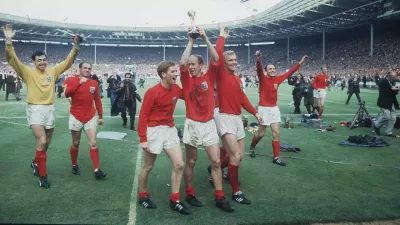
England have a long history in the FIFA World Cup, with their greatest achievement coming in 1966, when they won the tournament on home soil.
In that edition, England defeated West Germany 4-2 after extra time in the final at Wembley, securing their only World Cup title to date.
Since then, England have had several strong runs but have not managed to lift the trophy again. Their best performances in recent decades include:
- Fourth place at the 2018 World Cup in Russia
- Quarter finals at the 2022 World Cup in Qatar
England have consistently qualified for major tournaments and reached the knockout stages, but have often fallen short against other top nations in decisive matches.
- Overall Record
- World Cup titles: 1 (1966)
- Best recent finish: 4th place (2018)
Regular knockout stage appearances in recent tournaments.
English Team on World Cup 1966
- Historical Context
England’s World Cup history reflects a team that is regularly competitive but has struggled to convert strong squads into tournament victories.
This context adds to the pressure heading into 2026, as expectations remain high for a new generation of players to match or surpass the success of 1966.
The Best Bookmakers for World Cup 2026


Odds to Win the 2026 World Cup
England odds are consistently priced among the leading contenders for the 2026 World Cup, reflecting both squad quality and recent tournament performances.
Across the best bookmakers, the Three Lions are generally placed just behind Spain and France, but remain firmly within the top tier of favourites.
| Country | 
| 
| 
| 
|
|---|---|---|---|---|
| Spain | 9/2 | 9/2 | 9/2 | 9/2 |
| France | 11/2 | 11/2 | 5/1 | 11/2 |
| England | 6/1 | 6/1 | 6/1 | 13/2 |
| Argentina | 8/1 | 8/1 | 8/1 | 8/1 |
| Brazil | 8/1 | 8/1 | 8/1 | 8/1 |
| Portugal | 12/1 | 11/1 | 9/1 | 10/1 |
The odds show a consistent pattern. England are typically priced between 6/1 and 13/2, placing them among the top contenders across all major bookmakers.
Spain and France remain slightly ahead in most markets, but the gap is not significant, keeping England firmly in the conversation as a potential winner.
According to the odds, Portugal are considered the least likely to win the tournament.
Can England Win the 2026 World Cup?
England arrive at the 2026 World Cup as one of the most complete teams in the tournament, combining squad depth, attacking quality and increasing tactical flexibility under Thomas Tuchel. Recent results show a team that is dominant in qualifying and capable of controlling matches, but still searching for greater consistency against top level opposition.
The available talent, particularly in midfield and attack, gives England the tools to compete with any side. However, the key challenge remains translating that quality into performances in decisive moments, especially in knockout football where tactical detail and game management are critical.
From a market perspective, England’s position among the favourites reflects both belief and caution. The odds recognise their potential, but also underline the small margins that separate them from other leading contenders such as Spain and France.
Ultimately, England can win the 2026 World Cup, but doing so will require more than talent alone. If they achieve consistency, adapt effectively to high level opponents and maximise the impact of their key players, they have a realistic path to lifting the trophy.
✅ When does the 2026 World Cup start?
✅ When does England play their first match?
✅ Who could be in the England squad for 2026?
✅ Where can I bet on the World Cup?